
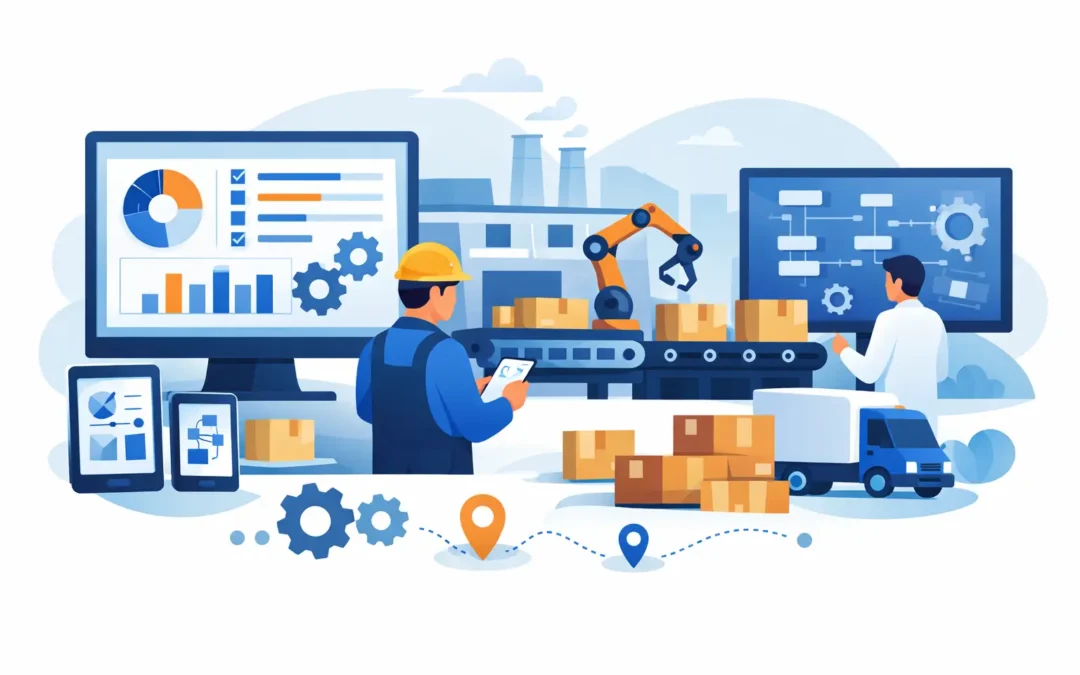
A late material issue on Monday morning can affect purchasing, production, delivery, invoicing, and cash flow by Friday. That is why production management software for manufacturers matters far beyond the shop floor. It is not just a scheduling tool. It is the system that connects orders, raw materials, work-in-progress, labor, finished goods, and financial outcomes in one controlled process.
For manufacturers trying to run with spreadsheets, disconnected stock records, and manual job updates, the cost shows up quietly at first. Production gets delayed because the wrong material version was issued. Actual output differs from planned output, but the variance is noticed too late. Rework increases, costing becomes unreliable, and management spends more time chasing status than improving performance. Software does not remove every production problem, but it gives the business a consistent structure for planning, execution, and reporting.
What production management software for manufacturers should actually do
At a practical level, production management software should help a manufacturer control the full flow from demand to finished product. That includes bill of materials management, work order creation, production scheduling, material issuance, WIP tracking, output recording, scrap monitoring, and finished goods updates. Good systems also connect these activities to purchasing, inventory, sales, and accounting.
This connection matters because production decisions are financial decisions. If a job consumes more raw material than expected, that affects margins. If output is delayed, customer delivery and cash collection move with it. If inventory records are inaccurate, purchasing may overbuy one item while production runs short on another. A production system that operates in isolation creates blind spots. A production system tied to the wider business creates control.
That is especially important for small and midsize manufacturers. These businesses often do not have large planning teams or separate systems for every function. They need software that is detailed enough to handle real operational complexity, but practical enough for daily use by supervisors, store staff, finance teams, and management.
Why manufacturers outgrow manual production control
Manual methods can work for a very small operation with a short product range and stable demand. Once product variations increase, customer requirements change more often, or multiple jobs run at the same time, manual control starts to break down.
The first issue is visibility. If job status depends on verbal updates or handwritten records, no one sees the full picture in real time. The second issue is consistency. Different staff may record materials, wastage, or completed units differently, which weakens costing and reporting. The third issue is traceability. When a customer asks which batch was used, which operator completed the work, or why the actual cost exceeded plan, the answer may take hours to assemble or may not be available at all.
Software brings discipline to these processes. It creates a standard workflow for issuing materials, capturing output, monitoring variances, and closing production jobs. That does not mean every manufacturer needs a highly complex manufacturing execution system. In many cases, a well-integrated production module within a broader business platform is the better fit because it supports both operations and finance without adding unnecessary layers.
The operational gains that matter most
Manufacturers usually start evaluating software because they want efficiency, but efficiency is only one part of the value. Better production management improves planning accuracy, stock control, job costing, and customer service at the same time.
Planning becomes more reliable when the system can compare demand against available materials and scheduled production. Supervisors can release jobs based on actual stock and current priorities instead of assumptions. Inventory accuracy improves because material issuance and finished goods receipts are recorded within the same workflow. This reduces the gap between what the system says is available and what is actually on the floor.
Costing also gets stronger. When actual material usage, scrap, labor, and output are captured correctly, management can compare estimated versus actual production cost by job or product. That is where many manufacturers find hidden margin loss. A product may look profitable on a standard cost basis but perform poorly in practice due to recurring waste, poor yield, or repeated setup inefficiencies.
Customer service benefits as well. If sales and operations can see production status clearly, they can commit delivery dates with more confidence and respond faster when changes happen. This is often more valuable than speed alone. Customers can usually handle a realistic lead time. What causes problems is uncertainty.
Key features to evaluate in production management software for manufacturers
The right feature set depends on the production environment. A process manufacturer, custom fabricator, assembler, and batch producer will not use software in exactly the same way. Even so, several capabilities consistently matter.
BOM and routing control should be easy to maintain. If updating components, quantities, or production steps is cumbersome, users will bypass the system. Work order management should allow businesses to issue jobs clearly, reserve or consume materials, and record progress without duplicate entry.
Inventory integration is non-negotiable. Production consumes stock and creates stock. If those movements sit outside the inventory system, errors multiply quickly. Purchasing integration is also important, especially where material shortages must trigger buying decisions.
Reporting should go beyond basic output counts. Manufacturers need visibility into planned versus actual usage, yield, scrap, downtime, job completion status, and production cost. For management teams, dashboards can make this information usable without waiting for end-of-month analysis.
If the business also needs accounting, payroll, compliance, and broader operations management, an integrated ecosystem can be a strong advantage. SQL Accounting, for example, is built around that kind of connected operating model, where finance and operational data work together instead of sitting in separate systems.
Integration matters more than feature volume
One common buying mistake is selecting software based on the longest feature list. In practice, integration quality often matters more. A system with every manufacturing feature but poor links to inventory, accounting, and purchasing can create extra reconciliation work and duplicate entry.
For many manufacturers, the better question is not “Does this software do everything?” but “Does this software support how our business actually runs?” If a supervisor records production, does stock update correctly? If purchasing receives materials, does production see availability immediately? If a job closes, does finance get accurate cost data without manual adjustment?
This is where trade-offs matter. A highly specialized manufacturing platform may offer deeper shop floor functions, but it can also require more implementation effort, more training, and more integration work. A broader business management platform with production capability may offer faster adoption and better cross-functional control, especially for small and midsize firms. The right choice depends on process complexity, internal resources, and reporting needs.
Common implementation mistakes to avoid
Software projects usually fail for operational reasons, not technical ones. The first mistake is trying to automate bad process discipline. If BOMs are outdated, stock units are inconsistent, or production steps vary informally from one shift to another, the software will expose those weaknesses rather than fix them.
The second mistake is overcomplicating the setup. Many manufacturers ask for every exception to be built into the system from day one. That slows implementation and makes user adoption harder. It is often better to start with core controls such as item structure, job creation, material issue, output recording, and variance reporting, then refine from there.
The third mistake is leaving finance out of the project. Production data affects inventory valuation, cost of goods sold, margin analysis, and purchasing decisions. If operations and finance are not aligned on how transactions should flow, reporting quality will suffer even if the production team uses the system consistently.
Training also needs to match real roles. Storekeepers, production supervisors, planners, and finance staff do not need the same screens or the same level of detail. Clear workflows are usually more valuable than long training sessions.
How to tell if your business is ready
A manufacturer does not need to be large to justify better production control. The signals are usually operational. Jobs are often late without a clear reason. Material shortages interrupt production even when the stock report looks healthy. Actual job cost is hard to verify. Management meetings focus on finding data rather than making decisions.
If that sounds familiar, the issue is not simply growth. It is control. Production software becomes valuable when the business reaches the point where manual coordination is no longer reliable enough to protect margin, service levels, and stock accuracy.
The strongest systems support that control without making day-to-day work harder. They give management better visibility, help teams follow a consistent process, and connect production activity to the financial results that matter.
A good manufacturing system should make the business easier to run on an ordinary Tuesday, not just more impressive in a demo. That is the standard worth buying against.