
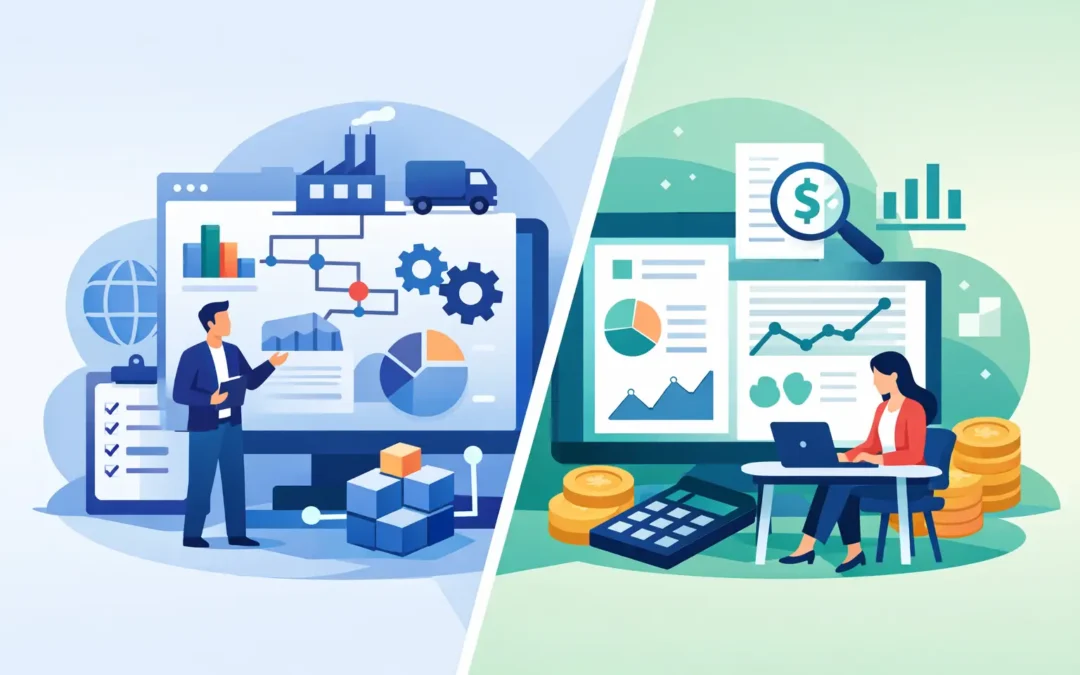
A finance team can close the month on time and still struggle to answer basic operational questions. Why is a high-selling item out of stock? Which jobs are over budget? Which branch is collecting cash slowly? That gap is where the erp vs accounting software decision becomes a real business issue, not just a software purchase.
For many companies, accounting software is the first system that brings structure to financial records. It helps manage general ledger, accounts receivable, accounts payable, bank reconciliation, tax reporting, and core financial statements. That is essential. But once a business adds inventory complexity, payroll requirements, sales channels, service operations, or multiple entities, financial accuracy alone is no longer enough. The question shifts from “Can we record transactions?” to “Can we control the business end to end?”
ERP vs accounting software: the core difference
The simplest way to separate ERP and accounting software is scope. Accounting software is built to manage financial transactions and reporting. ERP, or enterprise resource planning, extends beyond finance to connect operational processes in one system.
In practical terms, accounting software answers questions like whether invoices are paid, whether expenses are coded correctly, and whether the trial balance is accurate. ERP also addresses what is happening before and after the accounting entry. It can connect purchasing, sales, stock movement, payroll, production, service delivery, approvals, and management reporting so teams are working from the same data.
That distinction matters because many businesses do not fail due to weak bookkeeping. They lose time and margin because information is fragmented across spreadsheets, separate apps, manual handoffs, and duplicate data entry. Accounting software solves part of that problem. ERP is designed to reduce it across the wider business.
What accounting software does well
Accounting software remains the right fit for many smaller businesses, especially when operations are straightforward. If your main needs are invoicing, collections, vendor payments, expense tracking, and statutory reporting, a focused accounting system can be efficient and cost-effective.
It also tends to be faster to deploy. Finance teams usually need less training, setup can be lighter, and the buying decision is easier when only one department is involved. For owner-managed businesses or early-stage companies, that simplicity is valuable. A smaller system with disciplined processes can outperform a larger system that is badly implemented.
Another advantage is clarity. When accounting software is purpose-built for finance, users often find the interface more direct for day-to-day bookkeeping. There are fewer modules to manage, fewer configuration choices, and less risk of overbuying functionality that the business will not use.
Still, the trade-off is important. Once non-financial workflows start driving errors in the books, finance teams often become the cleanup function for operational problems. That is usually the point where companies begin to outgrow standalone accounting tools.
Where ERP becomes the better option
ERP becomes more valuable when business processes are connected and volume increases. A distributor needs inventory accuracy tied to purchasing and sales. A project-based company needs job costing linked to procurement, labor, and billing. A multi-entity group needs consolidated visibility with tighter controls. A business with payroll complexity, branch operations, or mobile sales teams needs data to move without rekeying.
In those cases, ERP improves more than reporting. It can reduce timing gaps between departments, standardize approvals, improve stock visibility, and give management a current operational picture instead of a delayed financial one. That is especially relevant when growth is creating pressure on finance, HR, warehouse, and sales teams at the same time.
ERP also supports stronger internal control. When inventory adjustments, purchasing approvals, payroll data, and sales transactions live in disconnected systems, audit trails become harder to maintain. Reconciliation takes longer, and accountability gets blurred. An integrated platform makes it easier to see where transactions originated and how they affect financial results.
ERP vs accounting software by business stage
The right choice often depends less on company size than on business complexity.
A small business with one location, low inventory exposure, and a simple staffing model may not need full ERP yet. It may benefit more from good accounting discipline, payroll accuracy, and basic reporting. On the other hand, a relatively small business with multiple warehouses, field sales, eCommerce orders, and recurring stock issues may need ERP capabilities far sooner than revenue alone would suggest.
Mid-market companies tend to feel the limitations more clearly. They usually have enough transaction volume to expose process weaknesses, but not enough surplus headcount to absorb manual fixes. This is where integrated systems start delivering measurable operational value. The goal is not to buy complexity for its own sake. The goal is to reduce friction across daily workflows.
For larger or fast-scaling businesses, ERP is often less about whether they need it and more about how broad the rollout should be. Some start with finance, inventory, and payroll, then extend into BI dashboards, mobile sales, production, HR, or industry-specific functions as requirements mature.
The cost question is more than subscription price
Businesses often compare ERP and accounting software based on upfront cost, but that view is too narrow. A cheaper system can become expensive if it creates duplicate work, weak visibility, stock variances, payroll errors, or delayed collections.
Accounting software usually costs less to purchase and implement. That is real value when requirements are narrow. But businesses should also account for indirect costs such as spreadsheet maintenance, extra admin labor, reconciliation time, and reporting delays. Those costs rarely appear on a software quote, yet they affect margin and management control every month.
ERP typically requires more planning, process design, and user training. That means higher commitment. But when implemented well, it can lower operational overhead by reducing manual touchpoints and improving data consistency. The return comes from fewer workarounds, faster reporting, and better decisions based on current information.
Compliance and control should not be an afterthought
For finance leaders, software selection is not only about convenience. It is also about control, traceability, and compliance readiness. Payroll, tax treatment, e-invoicing requirements, approval workflows, and audit support all place pressure on back-office systems.
This is one area where the erp vs accounting software choice deserves careful evaluation. If compliance requirements sit only within finance, accounting software may be enough. If they extend across payroll, HR, purchasing, inventory, and branch operations, a broader system often makes compliance more sustainable.
Businesses operating in regulated or operationally complex environments should look closely at whether the system supports local workflows, banking processes, statutory submissions, and reporting expectations. Generic software can appear cost-effective until it forces manual patches around local requirements.
Signs you have outgrown accounting software
The clearest warning sign is not that the accounting system fails. It is that people build a second business system around it using spreadsheets, chat approvals, exports, and separate apps. When that happens, the accounting package becomes the final destination for data instead of the source of control.
Other signs are familiar. Inventory does not match actual stock. Payroll data is re-entered from another tool. Sales and finance disagree on customer balances. Managers wait days for reports. Branches operate with different processes. Month-end closes depend on one or two key employees who know how to reconcile everything manually.
At that point, keeping a smaller system may feel cheaper, but it often introduces hidden operational risk. Growth becomes harder to manage because the process foundation is too dependent on individual effort.
How to choose without overbuying
The best buying decision starts with workflow, not software labels. Some vendors call a product accounting software even when it includes broader business functions. Others market ERP packages that are too heavy for the actual need. What matters is whether the system matches your operational model.
Begin with your current pain points. Are they financial, or are they process-related? If delays come from disconnected stock, payroll, sales, or approvals, then finance-only software may not solve the root issue. Next, look at what must integrate on day one and what can wait. A modular approach is often the most practical route because it supports control now without forcing a full enterprise rollout before the business is ready.
This is where a platform approach can make sense. A business may start with accounting and payroll, then add inventory, POS, mobile sales, BI, HR, or e-invoicing support as complexity increases. SQL Accounting is one example of this model, where companies can build from core finance into broader operations without switching between unrelated systems.
The better question is not which category sounds more advanced. It is which system gives your team reliable control over the work they do every day.
If your business mainly needs accurate books and straightforward financial management, accounting software may be the right choice for now. If your growth is exposing gaps between departments, an ERP approach can bring the structure needed to keep operations, compliance, and reporting aligned. The right system should make daily work easier to manage, not just easier to record.